NEUROBIBLISTICS: A MANIFESTO

We stand at a threshold where reading is no longer a neutral act. Texts are interpreted faster than ever, circulated more widely than ever, and mediated through systems that accelerate understanding while thinning encounter. In such a moment, the question is no longer simply What does Scripture mean? but What does Scripture do? Neurobiblistics begins here—at the point where interpretation meets formation, where the text moves beyond explanation and enters the shaping of human life.
Neurobiblistics is an interdisciplinary framework that examines how scriptural texts operate not only as objects of interpretation but as agents of cognitive, perceptual, and behavioral formation. It draws on Biblical Studies, Cognitive Science, and Neuroscience, not to collapse them into a single method, but to hold them in disciplined conversation. Its central claim is both simple and demanding: Scripture is not exhausted by what it means; it is fulfilled in what it forms.
For too long, biblical scholarship has been dominated by the question of meaning—historical context, linguistic precision, authorial intent, literary structure. These are necessary and indispensable. Yet they are not sufficient. A text may be perfectly understood and yet leave the reader unchanged. Neurobiblistics insists that this is not a neutral outcome but a failure of engagement. Scripture, in its own internal logic, resists being reduced to information. It calls for transformation.
This is not a rejection of interpretation but its completion. Neurobiblistics affirms that understanding precedes formation, but it refuses to let understanding terminate in itself. The movement is twofold: from informing to forming, from semantic clarity to embodied practice. The ancient distinction between explanation and enactment—between knowing and becoming—is not incidental to Scripture; it is constitutive of it.
To speak of formation is to speak of the human person in full. Cognition is not merely the processing of propositions; it includes attention, perception, memory, and imagination. Behavior is not merely outward action; it includes habits, dispositions, and patterns of response shaped over time. Neurobiblistics therefore asks: How does Scripture reorient attention? How does it train perception? How does it reshape memory? How does it cultivate habits of action?
The answers do not lie in abstraction alone. Scripture forms through practices: reading, hearing, repetition, prayer, and communal participation. It is encountered not only in study but in rhythm—in cycles of return, in liturgical proclamation, in embodied response. A text read once may inform; a text inhabited over time forms. The difference is not quantitative but qualitative. Formation requires duration, repetition, and participation.
In this sense, Scripture is not merely a text but a medium of mediation. It mediates a way of seeing the world, a way of interpreting experience, a way of acting within it. Neurobiblistics names this process without reducing it to mechanism. It does not claim that Scripture can be mapped directly onto neural pathways or measured in controlled environments. Such claims belong to other disciplines. Instead, it attends to the level at which cognition and practice meet—where patterns of thought and patterns of life begin to align.
This attention becomes especially urgent in an age shaped by artificial intelligence. Increasingly, texts are not encountered directly but through systems that interpret, summarize, and generate responses. These systems extend access but also introduce distance. They can inform rapidly, but they cannot form. They simulate understanding without participation, offering interpretation without embodiment. Neurobiblistics therefore serves as a critical framework for discerning what is gained and what is lost when scriptural engagement is mediated through non-human agents.
The question is not whether such mediation will occur—it already has—but how it will be understood. If Scripture is reduced to content, then any system capable of processing content may appear sufficient. But if Scripture is recognized as formative, then the limits of such systems become clear. Formation requires presence, repetition, and participation. It unfolds within communities, across time, through practices that cannot be outsourced or automated.
Here, the witness of the Orthodox Church offers a living counterpoint. Within its liturgical and sacramental life, Scripture is not merely read but enacted. It is chanted, proclaimed, embodied, and distributed across the gathered community. Meaning is not confined to the individual reader but shared, performed, and sustained through communal rhythm. The text becomes life not by being explained once, but by being lived repeatedly.
This does not render Neurobiblistics confessional or sectarian. Rather, it demonstrates that the framework is not purely theoretical. It corresponds to practices that have long understood what modern scholarship is only beginning to articulate: that the power of Scripture lies not only in its capacity to inform but in its capacity to transform.
The task, then, is not to replace existing methods but to extend them. Historical-critical analysis, literary study, and theological reflection remain essential. Neurobiblistics does not compete with these approaches; it reorients their telos. It asks not only What does this text mean? but What does this text make possible? Not only How was it understood? but How does it shape those who engage it?
This reorientation carries implications beyond the academy. For preaching, it shifts the goal from explanation to formation. For teaching, it emphasizes practices over mere content delivery. For personal engagement, it calls for a movement from occasional reading to sustained inhabitation. Scripture is no longer approached as a problem to be solved but as a reality to be entered.
At its core, Neurobiblistics is a call to recover the formative power of Scripture in an age that risks reducing it to information. It insists that the text is not complete until it is embodied, not fulfilled until it is lived. It challenges readers, scholars, and communities alike to move beyond interpretation into transformation.
To read Scripture, then, is not merely to understand it. It is to be addressed by it, shaped by it, and ultimately to become, in some measure, what it proclaims.
Neurobiblistics is not merely a theory to be considered but a practice to be undertaken. Its claims can only be tested in the act of engagement—through sustained reading, embodied participation, and communal life. The question it poses is not only whether Scripture can be understood, but whether it can still form a people.
The following volumes extend and apply this framework:
Synthetic Levites — implications in the age of artificial intelligence
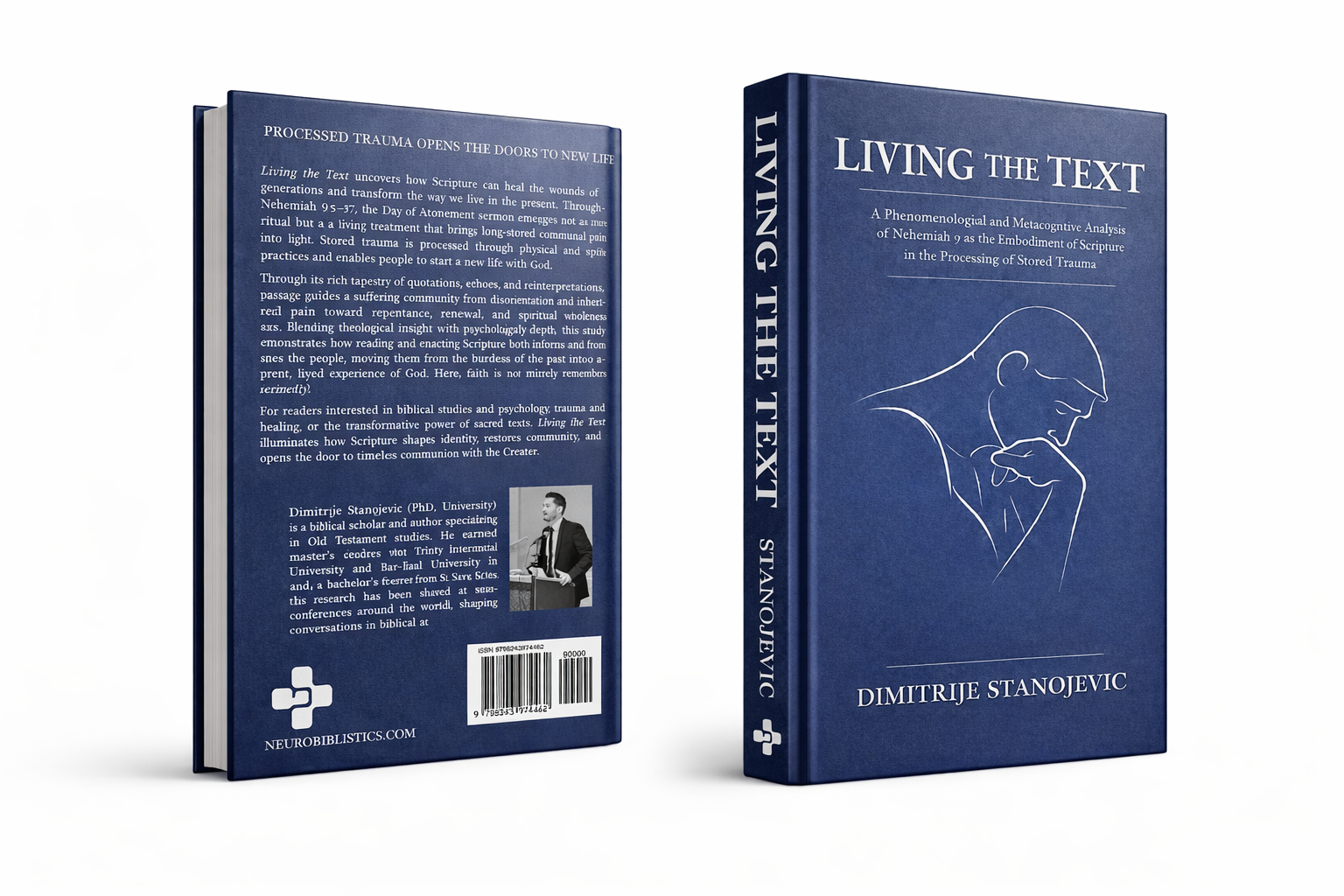
Living the Text — exegetical and conceptual foundations
How to Live the Text — practical and formative application